What happens when a momentum stock loses momentum?
It is one of the most important questions to ask when trying to understand a momentum index fund. A stock can have strong recent momentum today and weaker momentum a few months later. So what happens then? Does the index sell it immediately?
Not necessarily. The answer lies in the rules that sit behind the index.
What is the Nifty200 Momentum 30?
The Nifty200 Momentum 30 is a rules-based strategy index designed to track 30 high-momentum stocks from the Nifty 200 universe across large- and mid-cap companies. The index uses a Normalised Momentum Score based on recent 6-month and 12-month price returns, adjusted for volatility.
This distinction matters. The index is not simply selecting the 30 stocks with the highest recent returns. The methodology also considers the volatility associated with those returns.
How does the index select stocks?
At a simplified level, the process can be understood in three stages:
1. Select — Eligible stocks from the Nifty 200 are evaluated using their Normalised Momentum Scores. The score incorporates 6-month and 12-month price momentum, adjusted for volatility.
2. Weight — The final stock weight is not determined by momentum alone. The methodology combines the Normalised Momentum Score with the stock's free-float market capitalisation, subject to prescribed weight caps.
3. Rebalance — The index is formally rebalanced twice a year — on the last working day of June and December.
Selection = Momentum
Weight = Momentum + Free-float Market Capitalisation
How is this different from an actively managed mutual fund?
This is one of the most useful distinctions for investors to understand.
In an actively managed mutual fund, the fund manager has discretion within the scheme's mandate. If the manager's view on a company's fundamentals, valuation, price behaviour or new information changes, the manager can decide to reduce or exit a position, subject to the fund's mandate and practical constraints.
A rules-based momentum index works differently. There is no fund manager making a discretionary decision on every constituent every day. Instead, the index follows a predefined methodology and applies that methodology at its scheduled review.
Momentum can change every day.
The index doesn't automatically change with it.
What if a stock loses momentum in between reviews?
Suppose a stock's momentum starts weakening in September. That does not automatically mean the stock is removed from the Nifty200 Momentum 30 in September simply because its momentum has weakened.
The next scheduled review is in December. The index methodology also incorporates a buffer based on momentum ranks to reduce unnecessary turnover. There are provisions for exceptional index events, but ordinary changes in momentum are handled through the predefined review process.
This is fundamentally different from a discretionary active-management process. The index is systematic rather than manager-driven.
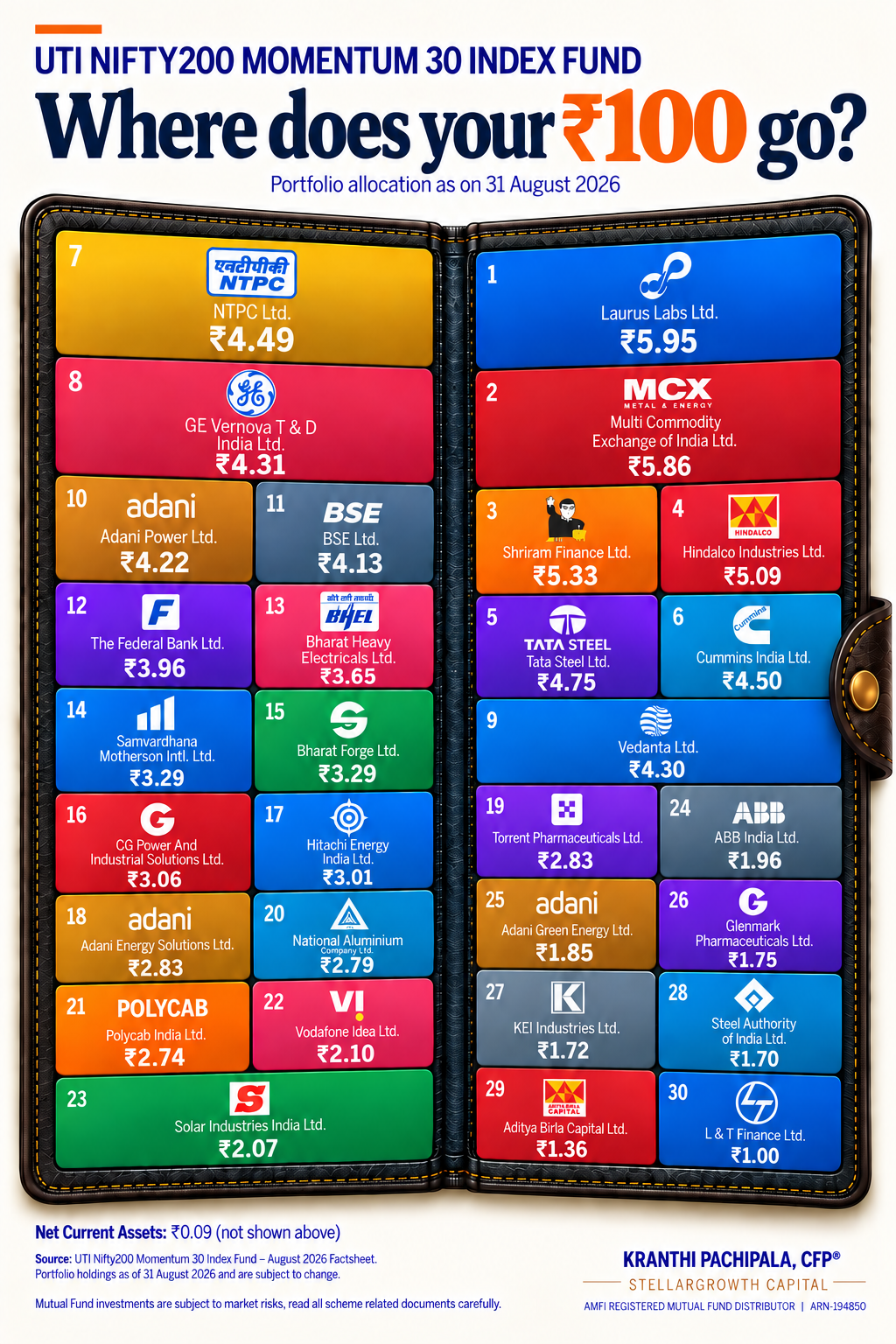
Where does ₹100 go?
The August 2026 portfolio of the UTI Nifty200 Momentum 30 Index Fund provides a useful snapshot of the output of this process. As of 31 August 2026, the portfolio contained 30 equity holdings, with the allocation spread across companies selected by the index methodology.
Looking at the portfolio is useful. But understanding the process behind the portfolio is even more important.
What does this mean for investors?
A momentum index fund should be understood as exposure to a particular investment factor and a predefined rules-based process. It is not the same thing as a broad-market index fund, and it is not the same thing as an actively managed mutual fund.
The distinction becomes particularly important when thinking about risk, diversification, investment horizon and portfolio construction. A factor strategy can behave differently from the broader market and can go through periods when its chosen factor is out of favour.
For someone working on broader financial planning, the more useful question is not simply, "Is momentum investing good or bad?" It is whether a particular strategy has a clearly understood role within the investor's overall portfolio, financial goals, time horizon and risk capacity.
How this fits into financial planning in Hyderabad
Investors in Hyderabad — whether salaried technology professionals, doctors, business owners or pre-retirement families — often have multiple financial decisions competing for the same capital. Mutual fund selection is only one part of that process.
A broader financial planning process can bring together goal planning, cash-flow management, mutual fund investments, risk management, retirement planning, insurance and long-term wealth management. The role of a financial planner is to help investors understand how different investment approaches fit into those broader objectives rather than looking at a fund in isolation.
The bigger lesson
When you look at a momentum index fund, you are not simply looking at 30 stocks.
You are looking at the current output of a predefined investment process.
That is why the better question is not only:
“What are the top holdings?”
It is also:
“How does the index decide what deserves to remain in those holdings?”
Conclusion
Momentum investing can look simple from the outside — buy stocks showing strong momentum. The reality is more structured. The Nifty200 Momentum 30 uses a defined methodology for measuring momentum, adjusts the score for volatility, combines the score with free-float market capitalisation for weighting, and reviews the index on a scheduled basis.
Understanding these mechanics can help investors look beyond a list of holdings and understand the behaviour of the strategy itself.
Sources
NSE Indices — Nifty200 Momentum 30
NSE Indices — Nifty200 Momentum 30 Indexogram / Factsheet
NSE Indices — Equity Index Methodology
NSE Indices — Index Rebalancing Schedule
Important Disclosure
This article is for informational and educational purposes only and should not be construed as investment advice or a recommendation to buy, sell or hold any security or mutual fund. The analysis is based on publicly disclosed information and our interpretation. While reasonable care has been taken in compiling and analysing the information, accuracy, completeness or timeliness cannot be independently guaranteed. Portfolio holdings and allocations may change without notice. Investors should refer to the latest official scheme documents and disclosures before making any investment decision.
Mutual Fund investments are subject to market risks, read all scheme related documents carefully.
KRANTHI PACHIPALA, CFP®
STELLARGROWTH CAPITAL
AMFI REGISTERED MUTUAL FUND DISTRIBUTOR | ARN-194850

